How to Tie a Windsor Knot
A step-by-step guide to the full Windsor: the wide, symmetrical, confident tie knot for spread collars and formal occasions.
The Windsor knot (properly, the full Windsor) is the big, balanced, self-assured knot you reach for when the occasion is formal and the collar is wide. It’s perfectly triangular and symmetrical, and once you’ve tied it a few times your hands will remember the sequence.
It uses a little more tie length than other knots, so if you’re tall or the tie runs short, account for that when you set the starting position. A spread or cutaway collar shows it off best. The whole sequence comes down to a simple rhythm: over, up, behind, up, across, up, and through. Follow the illustrated steps below, slowly the first time and at your collar rather than in front of you.
Getting it right
- Start long. The wide end needs a generous head start, about twice the drop of the narrow end. Too short and you’ll run out before the final pass.
- Keep tension even. Hold the knot loosely as it forms and only tighten at the end, sliding it up to the collar so it sits centred and snug.
- Match the collar. The Windsor’s width is built for a spread collar. On a narrow point collar it can look cramped.
- Mind the fabric. A thick, heavily lined tie makes an enormous knot. For the full Windsor, a lighter tie gives a cleaner result.
A well-tied Windsor finishes a suit like nothing else quite does. See where it belongs in business formal and black tie dressing, or how it pulls a wedding outfit together.
- 1
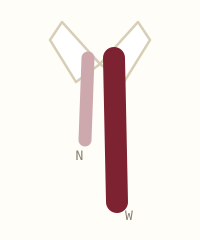
Set the starting length
Turn your collar up and drape the tie around your neck with the seam facing inward. Place the wide end on your right, hanging roughly twice as low as the narrow end, about 12 inches lower.
- 2
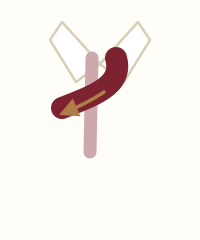
Cross wide over narrow
Cross the wide end over the narrow end to the left, holding the crossing point at your collar.
- 3
Up and through the neck loop
Bring the wide end up through the loop around your neck from underneath, then pull it down toward the left.
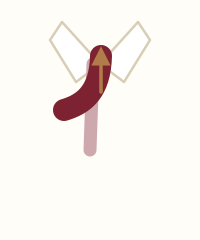
- 4
Wrap behind to the right
Take the wide end underneath the narrow end and pull it across to the right, so the back of the wide end now faces out.
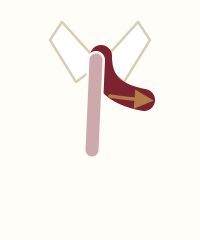
- 5
Up through the loop again
Bring the wide end up through the neck loop once more and pull it down. You should see a symmetrical triangle beginning to form.
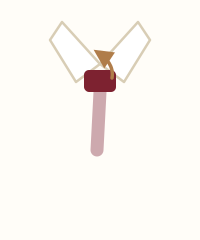
- 6
Across the front
Wrap the wide end across the front of the knot from right to left, creating the smooth front band.
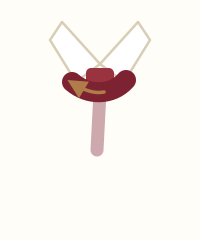
- 7
Through the front knot and tighten
Bring the wide end up through the neck loop a final time and pull it down through the front band you just made. Slide the knot up to the collar and even it out.
When should you wear a Windsor knot?
The Windsor suits formal and business settings, and it pairs best with a spread or cutaway collar. Its wide, symmetrical shape fills that collar's gap. For narrower collars or a more relaxed look, a four-in-hand or half-Windsor sits better.
What's the difference between a full Windsor and a half-Windsor?
The full Windsor (this knot) is larger, wider, and perfectly symmetrical, made with an extra wrap through the neck loop. The half-Windsor is a touch smaller and slightly less formal, and it works with a wider range of collars and tie fabrics.
Why does my Windsor knot come out too big?
The full Windsor is meant to be substantial, but a knot that swamps your collar usually means the tie is too thick for the knot. Switch to a lighter or thinner tie, or step down to a half-Windsor, which uses less length and bulk.
A stylist in your pocket.
Andy turns the clothes you already own into outfits that work — tuned to your taste, the weather, and the occasion.
Get Andy free